Types of Expenses: Business Costs, Accounting Categories, and Practical Examples
Understanding the main types of expenses makes it much easier to manage a business, build a budget, read financial statements, and make smarter spending decisions. Some costs stay fairly stable each month, while others rise and fall with sales or production. Meanwhile, certain expenses support daily operations, and others relate to long-term assets, financing, or unusual events. Knowing the difference helps business owners see where their money goes and which costs deserve closer attention.
For a beginner, expense categories may sound more complicated than they really are. In practice, most business spending can be organized by how the cost behaves, what purpose it serves, and how accountants record it.
What Are Business Expenses?
A business expense is a cost a company incurs while operating or carrying out business activities. Common examples include rent, employee wages, software subscriptions, advertising, office supplies, insurance, and shipping.
However, accountants do not treat every payment the same way. Companies record some spending as an expense immediately, while they may record other purchases as assets and recognize their costs gradually.
For example, paying a monthly internet bill is usually a normal operating expense. Buying an expensive piece of machinery, on the other hand, may qualify as a capital asset that the company depreciates over time.
That distinction matters because expenses affect profit, tax reporting, cash flow, and financial planning in different ways.
Main Types of Expenses in Business
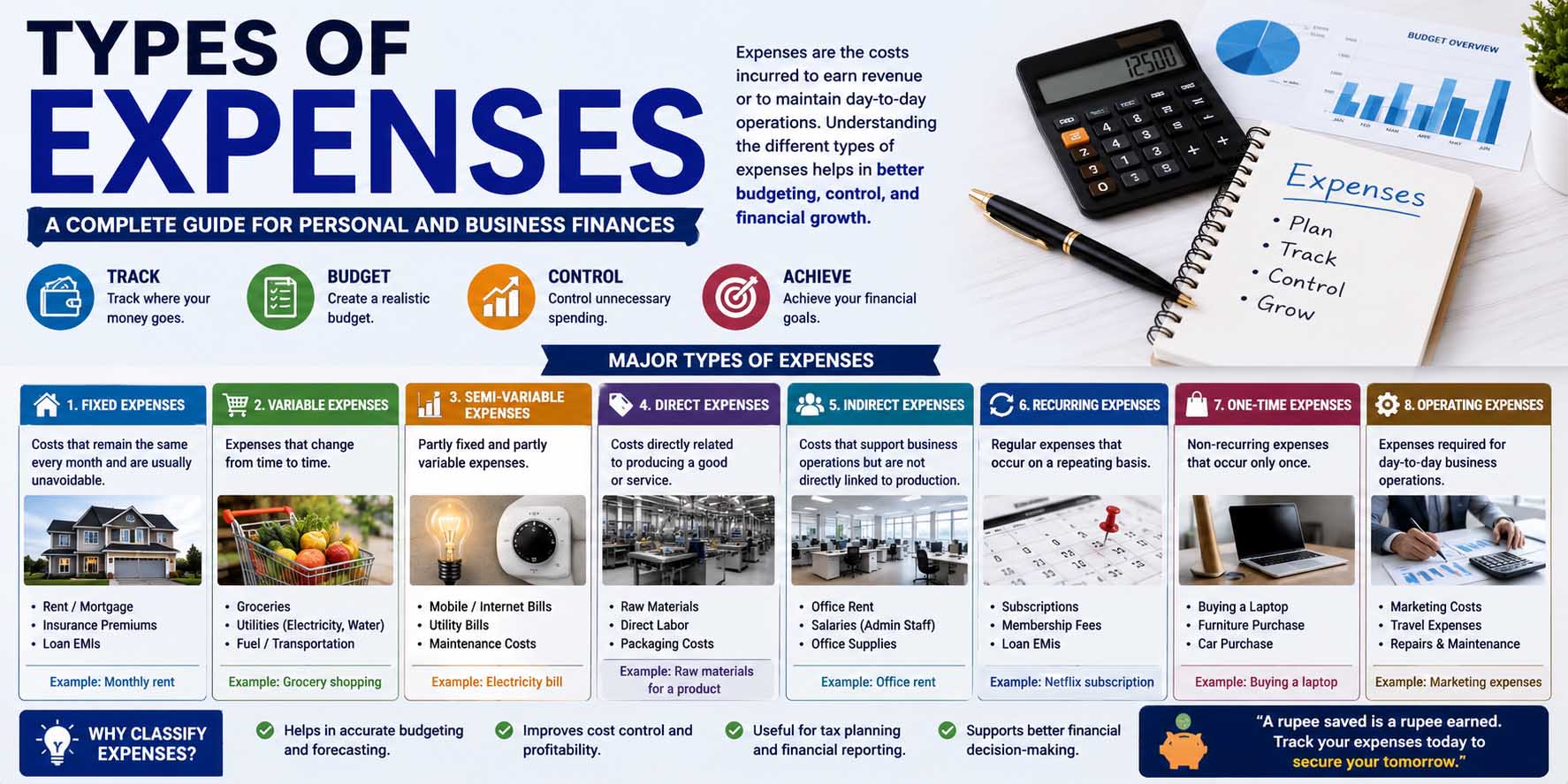
Businesses often classify expenses according to whether they are fixed, variable, operating, non-operating, direct, indirect, or capital-related.
These categories can overlap. For instance, rent may be both a fixed expense and an operating expense.
Fixed Types of Business Expenses
Fixed expenses generally stay the same or remain within a predictable range regardless of short-term sales volume.
Common examples include:
- Office or store rent
- Insurance premiums
- Software subscriptions
- Lease payments
- Salaried administrative staff
- Certain loan payments
A business may still pay these costs during a slow month. Therefore, fixed expenses are especially useful when calculating the minimum revenue needed to keep operating.
Utilities can sometimes appear relatively fixed, although usage may cause them to change from month to month. If you are reviewing overhead costs, understanding What Are Utilities can help clarify where electricity, water, gas, internet, and similar services fit into a business budget.
Variable Types of Business Expenses
Variable expenses change based on production, sales, customer demand, or business activity.
For example, a company that sells more products may spend more on packaging, shipping, transaction fees, and raw materials.
Typical variable expenses include:
- Shipping costs
- Packaging
- Sales commissions
- Payment processing fees
- Hourly labor tied to production
- Raw materials
Because these expenses usually rise as business activity increases, they are closely connected to revenue generation.
Direct and Indirect Types of Expenses
Another useful way to classify costs is by whether a business can trace them directly to a product, service, or project.
Direct Expenses
Direct expenses are closely tied to producing a specific product or delivering a particular service.
For example, a furniture maker may classify lumber as a direct cost because it goes directly into the finished product.
Likewise, a consulting business may treat contractor hours assigned to a specific client project as a direct cost.
These expenses help managers calculate product margins and understand how much it actually costs to deliver what the business sells.
Indirect Expenses
Indirect expenses support the business as a whole rather than one particular product or customer.
Examples include:
- Office rent
- Administrative salaries
- Accounting fees
- General insurance
- Office software
- Cleaning services
Businesses often call these costs overhead.
Since overhead supports the broader operation, companies usually allocate or monitor it separately from direct production costs.
Types of Expenses in Accounting
The types of expenses in accounting are often grouped according to how they appear on financial statements and how closely they relate to core operations.
Operating Expenses
Operating expenses cover the normal day-to-day costs of running a business.
Common operating expenses include rent, payroll, marketing, professional services, utilities, office supplies, and software.
Businesses generally separate these costs from the direct cost of producing goods or services.
For example, a retailer may record product inventory costs separately from store rent and advertising.
Cost of Goods Sold
Cost of goods sold, often abbreviated as COGS, represents the direct costs associated with products a business sells.
For a retailer, this usually includes the cost of purchasing inventory.
For a manufacturer, COGS may include raw materials and certain direct production labor.
This category matters because subtracting COGS from revenue gives gross profit.
As a result, business owners can see whether the products themselves generate enough margin before accounting for overhead.
Non-Operating Expenses
Non-operating expenses are costs outside the company’s main business activity.
Interest expense is a common example.
A company may also experience losses related to asset sales or unusual financial events that sit outside normal operating expenses.
Separating these costs helps managers evaluate how well the core business is performing.
Capital Expenses Versus Operating Expenses
Capital expenditures differ from ordinary operating expenses because they generally involve assets that provide value for more than one accounting period.
Examples may include:
- Buildings
- Vehicles
- Large machinery
- Major equipment
- Certain technology systems
Rather than treating every qualifying purchase as an immediate expense, a business may need to capitalize the asset and recognize its cost over time through depreciation or amortization.
This approach helps match an asset’s cost with the periods in which the business benefits from using it.
For that reason, a company buying a delivery truck may account for the purchase differently from monthly fuel expenses.
Businesses comparing internal purchasing processes may also benefit from understanding What Is Procurement, since procurement includes the planning, sourcing, approval, and purchasing of goods and services used by an organization.
Common Types of Business Expenses by Department
The exact types of business expenses depend on the company, industry, and size.
However, most businesses encounter several common categories.
Payroll and Employee Costs
Employee expenses often represent a significant part of a business budget.
They may include:
- Salaries
- Hourly wages
- Payroll taxes
- Benefits
- Bonuses
- Training
- Recruitment costs
Therefore, businesses should look beyond base salary when estimating the true cost of employees.
Marketing and Sales Expenses
Marketing expenses may include digital advertising, content production, print materials, events, sponsorships, email platforms, and sales tools.
Some businesses also pay commissions or referral fees.
Because marketing spending should support business growth, companies often compare these costs with the leads, customers, and revenue they generate.
Technology Expenses
Modern companies often spend heavily on software and technology.
Examples include:
- Accounting platforms
- Customer relationship management software
- Cloud storage
- Cybersecurity services
- Website hosting
- Communication tools
Many of these costs operate on monthly subscription models. As a result, they can be easy to overlook when managers review expenses one service at a time.
Professional Services
Businesses often pay outside professionals for specialized knowledge.
Examples include accountants, lawyers, consultants, designers, engineers, and IT providers.
These costs can provide value when internal staff lack the needed expertise.
Types of Expenses for Business: Practical Examples
The best way to understand different types of expenses is to look at real operating situations.
Suppose a small restaurant pays $4,000 in monthly rent, $12,000 in wages, $8,000 for food ingredients, and $2,000 for marketing.
Rent is largely fixed. Ingredient costs are more variable because they rise or fall with customer volume. Meanwhile, wages may include both fixed and variable elements depending on staffing.
Restaurant owners face especially complex cost structures because they must manage food, labor, utilities, equipment, spoilage, and occupancy expenses together. Someone evaluating that industry may find How to Start a Restaurant useful for seeing how these costs fit into a broader startup and operating plan.
Now consider a trucking business. Fuel, tolls, driver pay, repairs, insurance, financing, and vehicle depreciation can all influence profitability.
In that industry, fuel tends to behave more like a variable expense, while insurance and certain financing costs may be more predictable. A broader guide on How to Start a Trucking Company can help explain how those expense categories affect planning in a transportation business.
What Types of Expenses Should You Make a Savings Plan For?
If you are asking what costs deserve a dedicated savings plan, the best candidates are usually predictable expenses that do not occur every month.
Businesses often get into trouble because they budget only for recurring monthly bills.
Instead, consider setting aside money for:
- Annual insurance premiums
- Equipment replacement
- Repairs and maintenance
- Tax payments
- License renewals
- Seasonal inventory
- Technology upgrades
- Legal or professional fees
- Emergency expenses
A sinking fund can work well for these costs. In simple terms, you save a smaller amount regularly so a large future bill does not create a sudden cash-flow problem.
For example, if a company expects a $6,000 annual software renewal, setting aside $500 per month makes the expense more manageable.
Why Different Expense Categories Matter
Expense categories are not just for accountants.
Business owners use them to understand profitability, compare departments, build forecasts, control spending, and set prices.
For example, if variable costs rise faster than revenue, product margins may be shrinking.
On the other hand, if fixed overhead becomes too high, the business may struggle during slower periods.
Knowing the difference between finance and accounting also helps here. Accounting records and organizes transactions, while finance focuses more heavily on planning, funding, investment decisions, and future financial performance.
Both areas rely on accurate expense information.
For broader planning, the U.S. Small Business Administration’s guidance on calculating business startup costs also shows how businesses can organize common costs when estimating how much money they will need.
Common Expense Management Mistakes
One common mistake is combining personal and business spending.
That makes recordkeeping harder and can create problems when preparing financial statements or tax records.
Another mistake is failing to record small recurring subscriptions.
One $20 subscription may not matter much, but dozens of forgotten services can quietly create a large monthly cost.
Businesses also make mistakes when they focus only on cutting expenses.
Reducing costs can improve profit, but aggressive cuts may also damage customer service, product quality, employee productivity, or future growth.
Instead, evaluate whether each expense creates enough value for the business.
How to Track Different Types of Expenses
Start by creating consistent expense categories in your bookkeeping system.
Then, use the same categories every month.
For example, avoid recording software as “office expense” one month and “technology expense” the next unless there is a good reason.
Next, review expenses regularly rather than waiting until the end of the year.
A monthly review can reveal:
- Unexpected cost increases
- Duplicate subscriptions
- Higher supplier prices
- Overspending by department
- Unused services
- Seasonal patterns
Also, compare actual expenses with the budget.
If a category consistently runs above budget, investigate why instead of simply increasing the budget every month.
FAQs About Types of Expenses
What Are the Most Common Business Expenses?
Common expenses include payroll, rent, utilities, inventory, software, insurance, marketing, professional fees, transportation, and office supplies.
What Is the Difference Between Fixed and Variable Expenses?
Fixed expenses remain relatively stable even when sales change, while variable expenses generally rise or fall with business activity.
Is Payroll a Fixed or Variable Expense?
It can be either. Salaried staff may create more fixed payroll costs, while hourly or seasonal labor may behave more like a variable expense.
Are Taxes Considered Business Expenses?
Some business taxes may qualify as expenses, while others receive different accounting or tax treatment. Because rules vary by jurisdiction and tax type, businesses should follow applicable accounting standards and consult a qualified tax professional when needed.
Is Equipment an Expense?
A business may expense some smaller equipment purchases immediately, while larger purchases may need to appear as capital assets that the business depreciates over time. The correct treatment depends on accounting rules, tax rules, company policies, and the asset’s value and useful life.
Build Better Decisions From Better Expense Data
Understanding the different types of expenses gives business owners a clearer picture of where money goes and how costs affect profit.
First, separate fixed and variable costs. Then, distinguish direct production costs from overhead and review operating expenses separately from capital or non-operating items.
From there, track each category consistently and compare actual spending against your budget.
The goal is not to eliminate every cost. Instead, focus on whether each expense supports operations, protects the business, improves efficiency, or contributes to growth. When expense data is organized clearly, budgeting, pricing, forecasting, and business decision-making become much easier.